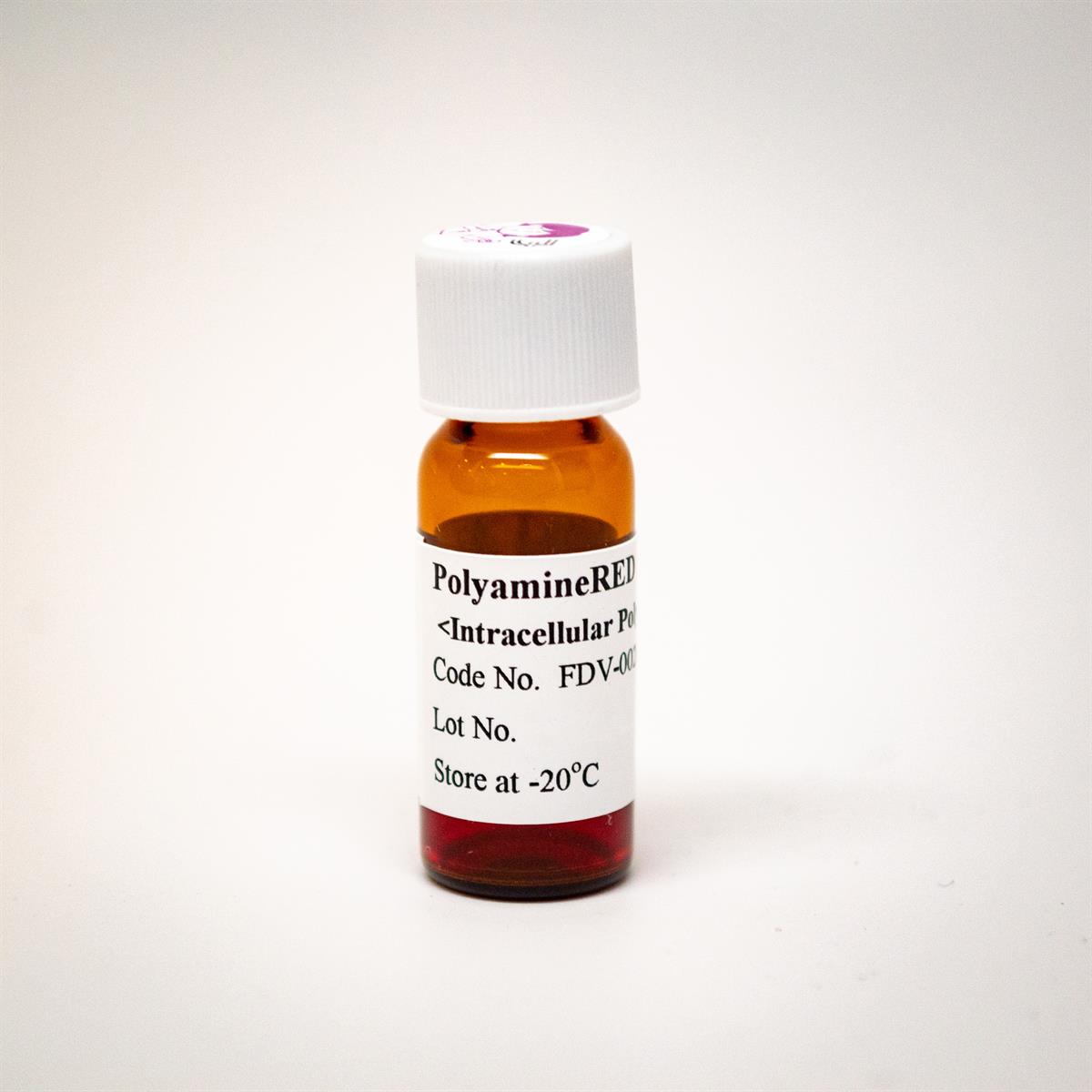
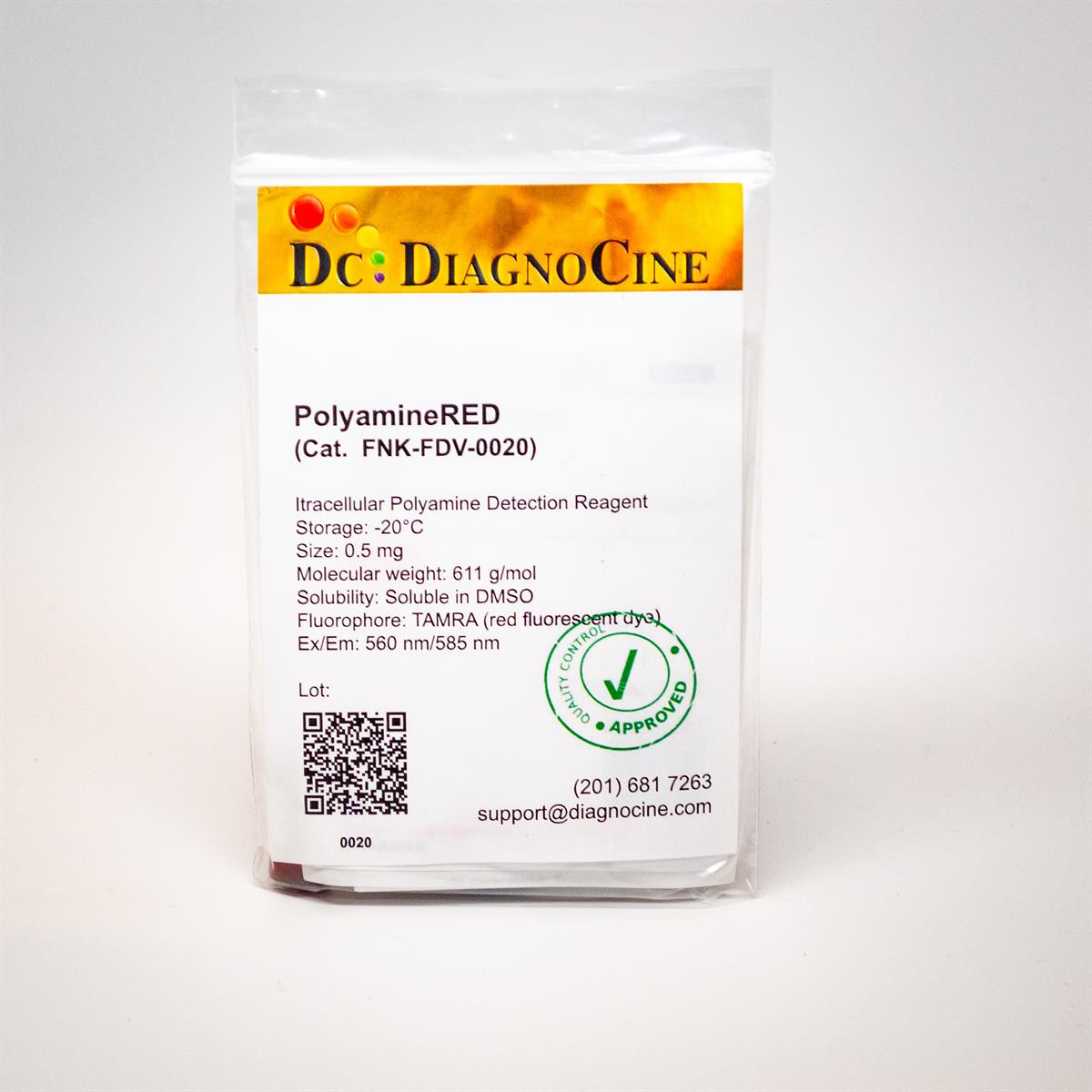

PolyamineRED (Intracellular Polyamine Detection Reagent)
PolyamineRED (Intracellular Polyamine Detection Reagent)
Labels intracellular polyamines in live cells with the red fluorescent dye TAMRA (Ex 560 nm / Em 585 nm), with no pretreatment or cell lysis.
For Research Use Only.
Overview
Polyamines, including putrescine, spermidine, spermine and their acetyl derivatives, are an essential class of metabolites with a linear alkyl structure carrying two or more amines. Polyamines are found in all living organisms at high intracellular concentrations, from sub-millimolar to millimolar. They are polycationic and have a wide range of biological functions. For example, polyamines interact with DNA and RNA in the nucleus and regulate gene expression. They also interact with negatively charged proteins and control their function.

The major source of polyamines is the amino acid ornithine. In mammals, ornithine decarboxylase (ODC) converts ornithine to putrescine, which is then used to synthesize spermidine and spermine. Because ODC is highly expressed in cancer cells, polyamines are considered cancer markers.
Several methods for detecting polyamines have been developed, but most are low-throughput HPLC methods that use polyamine standard compounds. As a result, the biological functions of polyamines in cells have remained unclear, and an easy, high-throughput cell-based assay is needed.
This product was commercialized with the support of the Biofunctional Synthetic Chemistry Laboratory, RIKEN.
Detection Principle
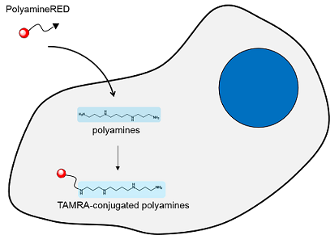
PolyamineRED is the world’s first reagent for detecting intracellular polyamines without any pretreatment or cell lysis. It can be used on live cells for detection and semi-quantitative analysis of intracellular polyamines.
PolyamineRED is a TAMRA (tetramethylrhodamine)-conjugated derivative of glycine propargyl ester. It reacts specifically with linear primary alkylamines and does not react with secondary amines, bulky amines including amino acids, or monoamines.
Selectivity of Glycine Propargyl Ester for Polyamines
| Amine | Reaction |
|---|---|
| Spermine | 82% |
| Spermidine | 78% |
| Putrescine | 66% |
| Epinephrine | <1% |
| Lysine | 2% |
Benzyloxycarbonyl glycine propargyl ester, used as a model molecule, reacted selectively with polyamines. Reaction products of epinephrine (a monoamine) and lysine (an amino acid) were rarely detected. Reactivity depends on polyamine length, and double-linkage products were observed from spermine (4 amino groups) and spermidine (3 amino groups).
Data from Ref. 1.Key Features
Specifically labels polyamines.
Detectable with a filter set for rhodamine (Ex/Em = 560/585 nm).
Compatible with live-cell imaging. No pretreatment required.
Semi-quantification of total polyamine amount by intracellular fluorescence intensity.
Specifications
| Size | 0.5 mg |
|---|---|
| Molecular weight | 611 g/mol |
| Solubility | Soluble in DMSO |
| Fluorophore | TAMRA (red fluorescent dye) |
| Storage | -20°C |
Optical Properties
Reconstitution & Storage
Application Data
Polyamine Imaging in Cancer and Non-Cancer Cells
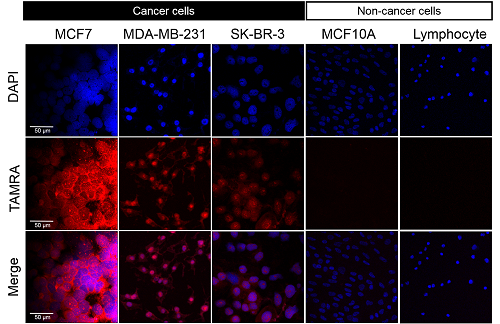
Three cancer cell lines (MCF7, MDA-MB-231 and SK-BR-3) and two non-cancer cell types (MCF10A and human lymphocytes) were treated with 30 µM PolyamineRED for 10 min. The cells were washed three times with PBS, stained with DAPI and fixed with formalin. Images were acquired at Ex/Em = 560/585 nm for TAMRA and Ex/Em = 358/461 nm for DAPI. TAMRA fluorescence was detected in the cancer cell lines.
Intracellular Distribution of Polyamines in MDA-MB-231 Cells
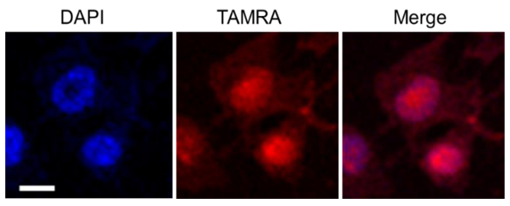
MDA-MB-231 cells were treated with 30 µM PolyamineRED for 10 min, washed three times with PBS, stained with DAPI and fixed with formalin. Images were acquired at Ex/Em = 560/585 nm for TAMRA and Ex/Em = 358/461 nm for DAPI. The major TAMRA signal was detected in the nucleus, indicating that polyamines in MDA-MB-231 cells are mainly localized in the nucleus.
Video: PolyamineRED
References
Research use only; not for human or animal therapeutic or diagnostic use.
- Vong K., Tsubokura K., Nakao Y., Tanei T., Noguchi S., Kitazume S., Taniguchi N., Tanaka K. (2017). Cancer cell targeting driven by selective polyamine reactivity with glycine propargyl esters. Chem. Commun., 53, 8403–8406. 10.1039/C7CC01934C
- Fiches G.N., Wu Z., Zhou D., Biswas A., Li T.-W., Kong W., Jean M., Santoso N.G., Zhu J. (2022). Polyamine biosynthesis and eIF5A hypusination are modulated by the DNA tumor virus KSHV and promote KSHV viral infection. PLoS Pathog., 18(4), e1010503. 10.1371/journal.ppat.1010503
- Shu S., Kobayashi M., Marunaka K., Yoshino Y., Goto M., Katsuta Y., Ikari A. (2022). Magnesium supplementation attenuates ultraviolet-B-induced damage mediated through elevation of polyamine production in human HaCaT keratinocytes. Cells, 11(15), 2268. 10.3390/cells11152268
- Ueno D. et al. (2023). Spermidine improves angiogenic capacity of senescent endothelial cells, and enhances ischemia-induced neovascularization in aged mice. Sci. Rep., 13(1), 8338. PMC10205711
- Chen D. et al. (2024). Trained immunity of intestinal tuft cells during infancy enhances host defense against enteroviral infections in mice. EMBO Mol. Med., 16(10), 2516–2538. PMC11479266
- Kang M. et al. (2022). Aggregation or phase separation can be induced in highly charged proteins by small charged biomolecules. Soft Matter, 18(17), 3313–3317. 10.1039/D2SM00384H
- Sesen J., Martinez T., Busatto S., Poluben L., Nassour H., Stone C., ... & Ghalali A. (2025). AZIN1 level is increased in medulloblastoma and correlates with c-Myc activity and tumor phenotype. J. Exp. Clin. Cancer Res., 44(1), 56. 10.1186/s13046-025-03274-1
- Fernando V., Zheng X., Sharma V., Sweef O., Choi E.S., Furuta S. (2024). Reprogramming of breast tumor-associated macrophages with modulation of arginine metabolism. Life Sci. Alliance, 7(11), e202302339. PMC11350068
- Hammoud B., Nelson J.B., May S.C., Tersey S.A., Mirmira R.G. (2024). Discordant effects of polyamine depletion by DENSpm and DFMO on β-cell cytokine stress and diabetes outcomes in mice. Endocrinology, 165(3), bqae001. 10.1210/endocr/bqae001
- Rana A.B. et al. (2025). Polyamine acetylation mediates crosstalk between cancer cells and myeloid cells to promote mesenchymal/plurimetabolic states in glioblastoma. Neuro-Oncology, 27(10), 2574–2591. 10.1093/neuonc/noaf128
- Xie K. et al. (2025). The yeast-fermented garlic and a balance of spermine/spermidine activates autophagy via EGR1 transcriptional factor. Mol. Nutr. Food Res., 69(5). PMC11874185
- Hosoi T. et al. (2023). Sarcopenia phenotype and impaired muscle function in male mice with fast-twitch muscle-specific knockout of the androgen receptor. Proc. Natl. Acad. Sci. USA, 120(4). 10.1073/pnas.2218032120
- Pérez-Riesgo E. et al. (2023). Transcriptional basis of Ca2+ remodeling reversal induced by polyamine synthesis inhibition in colorectal cancer cells. Cancers, 15(5), 1600. PMC10000432
- Hoang L.D. et al. (2023). Positive regulation of S-adenosylmethionine on chondrocytic differentiation via stimulation of polyamine production and the gene expression of chondrogenic differentiation factors. Int. J. Mol. Sci., 24(24). PMC10743985
- Umeda H. et al. (2025). ADAR1-high tumor-associated macrophages induce drug resistance and are therapeutic targets in colorectal cancer. Mol. Cancer, 24(1), 116. 10.1186/s12943-025-02312-y
- Fernando, Veani, et al. "Reprogramming of Breast Tumor–Associated Macrophages with Modulation of Arginine Metabolism." Life Science Alliance, vol. 7, no. 11, 2024, p. e202302339. PubMed Central, https://pmc.ncbi.nlm.nih.gov/articles/PMC11350068/.